





How Enterprises Can Move From Compliance Reporting to Sustainability Intelligence
Introduction
Sustainability has become a strategic priority for organizations across industries.
Companies are investing in ESG programs, emissions measurement, sustainability reporting and responsible business practices.
However, many organizations face a common challenge:
They can produce sustainability reports, but can they confidently use sustainability data to make better decisions?
Traditional ESG processes often depend on manual data collection, spreadsheets, disconnected systems and time-consuming validation activities.
The future of ESG is moving beyond reporting.
It is about creating a connected sustainability intelligence capability where organizations can collect, understand, analyze and act on ESG information continuously.
The Challenge With Traditional ESG Reporting
Many organizations collect ESG information from different parts of the business:
- Operations
- Facilities
- Business units
- Suppliers
- Partners
- Enterprise systems
- Documents and records
While the data exists, it is often distributed across multiple sources.
This creates challenges:
- Manual consolidation
- Limited visibility
- Data ownership confusion
- Difficulty validating information
- Time-consuming reporting cycles
- Limited ability to identify improvement opportunities
The challenge is not only producing a report.
The challenge is trusting the information behind the report.
From Reporting to Intelligence
Traditional ESG approach:
Collect Data → Prepare Report → Submit Disclosure
This approach is necessary, but it is often reactive.
A modern sustainability intelligence approach moves further:
Collect → Validate → Measure → Analyze → Identify Risks → Improve
This enables organizations to understand not only what happened, but also what actions can improve future performance.
Building a Trusted ESG Data Foundation
Reliable sustainability decisions require reliable information.
A strong ESG foundation requires:
Structured Data Collection
Organizations need a consistent way to gather ESG information from:
- Internal teams
- Facilities
- Business units
- Suppliers
- Partners
Data Validation and Evidence Management
ESG information must be supported by evidence.
Organizations need visibility into:
- Where the data came from
- Who provided it
- How it was validated
- What documentation supports it
This creates stronger confidence in sustainability reporting.
Connected ESG Workflows
ESG involves multiple stakeholders.
A connected process helps manage:
- Data submissions
- Reviews
- Approvals
- Documentation
- Reporting activities
Understanding Scope 1, Scope 2 and Scope 3 Emissions
A complete sustainability view requires understanding emissions across the value chain.
Scope 1
Direct emissions from sources owned or controlled by the organization.
Examples:
- Company facilities
- Manufacturing operations
- Owned equipment
Scope 2
Indirect emissions associated with purchased energy.
Examples:
- Electricity consumption
- Purchased heating or cooling
Scope 3
Indirect emissions across the wider value chain.
Examples:
- Suppliers
- Transportation
- Purchased goods
- Customer use
- Business activities beyond direct operations
Scope 3 visibility is often more complex because it requires collaboration beyond organizational boundaries.
Extending ESG Beyond Organizational Boundaries
Modern sustainability requires looking beyond internal operations.
Suppliers and partners increasingly play an important role in ESG performance.
Organizations need the ability to:
- Engage suppliers
- Collect sustainability information
- Assess performance
- Track improvements
- Maintain evidence
A connected ESG approach creates visibility across the value chain.
The Role of AI in Sustainability Intelligence
Artificial Intelligence can enhance ESG management by helping organizations work with complex sustainability information.
Potential applications include:
AI-Assisted Analysis
Helping teams identify patterns and insights within ESG data.
Risk Identification
Supporting organizations in identifying areas requiring attention.
Reporting Assistance
Helping transform structured ESG information into reporting outputs.
Predictive Analysis
Using available information to support forward-looking sustainability decisions.
Connecting ESG With Enterprise Systems
ESG does not operate separately from business operations.
Sustainability information is connected to:
- Enterprise resource planning systems
- Supply chain operations
- Procurement activities
- Financial information
- Operational processes
Connecting ESG data with enterprise systems helps organizations create a more complete understanding of business performance.
The Future of ESG: From Compliance to Capability
The next generation of ESG management will not only focus on producing disclosures.
It will focus on creating a sustainability intelligence capability.
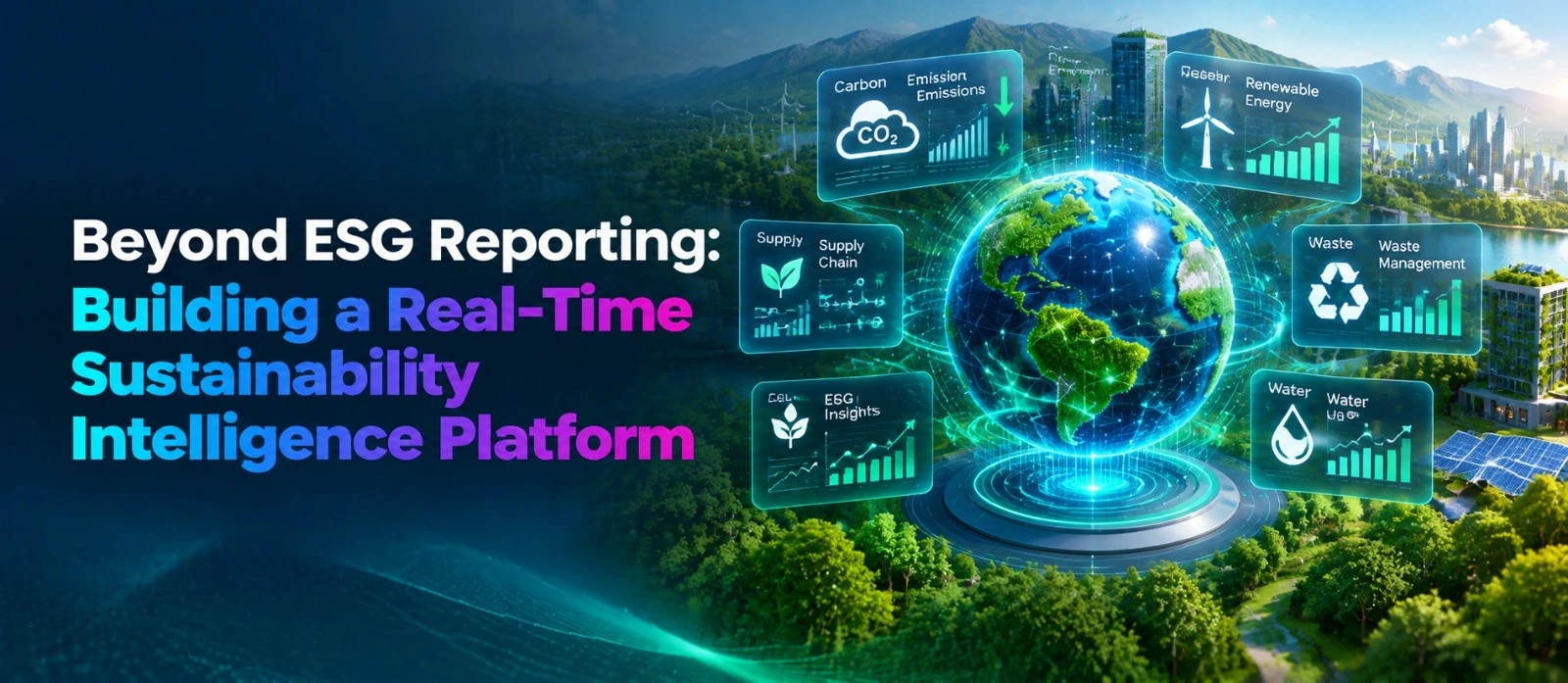
Organizations will need platforms that connect:
Data
Collect sustainability information from across the organization.
↓
Measurement
Understand emissions and ESG performance.
↓
Intelligence
Identify trends, risks and opportunities.
↓
Action
Support better sustainability decisions.
Why Sustainability Intelligence Matters
A connected ESG approach helps organizations:
- Improve data confidence
- Increase reporting transparency
- Understand sustainability risks
- Engage suppliers effectively
- Support strategic decision-making
- Build long-term resilience
ESG becomes more valuable when it moves from a reporting activity into the operating model of the business.
Conclusion
The future of sustainability is not only about producing better reports.
It is about creating better understanding.
Organizations that successfully connect ESG data, enterprise systems, analytics and intelligence will be better prepared to manage sustainability challenges and opportunities.
The journey is moving from:
ESG Reporting
to:
ESG Intelligence
to:
Sustainable Business Transformation
The organizations that build this capability today will be better positioned for the sustainability expectations of tomorrow.
Trusted data creates confidence.
Sustainability intelligence creates action.
Recent Articles
-
How Enterprises Can Move From Compliance Reporting to S...
 By Atominos Team • Sep 24, 2026
-
Why Enterprises Need to Move From Data Visibility to De...
By Atominos Team • Sep 24, 2026
-
From AI Pilots to Enterprise Execution: Why Businesses ...
By Atominos Team • Sep 24, 2026